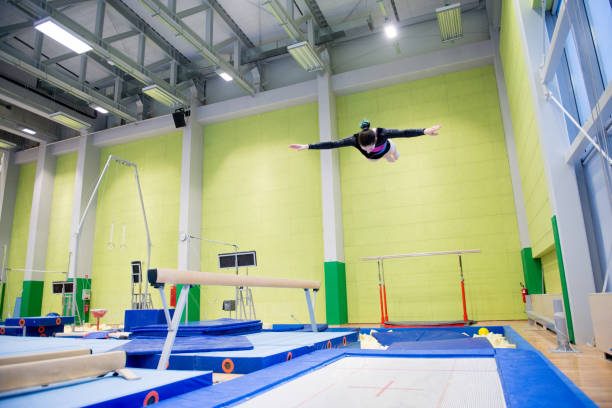
A soft landing surface is only one part of a safe training set-up. The height of a potential fall, the gymnast’s movement, the landing direction and the possibility of missing the intended area all affect what protection is appropriate. Choosing crash mats by appearance or maximum thickness alone can miss these details. Coaches and facility managers should first identify the skill, likely landing positions and the supervision required.
A controlled dismount differs from an unexpected fall during a new skill. Participants may land on their feet, roll onto a shoulder or come down at an awkward angle. The protective system therefore needs to suit the realistic range of outcomes, not just the ideal demonstration. Consider whether other mats are needed around the main landing area, especially if a person might travel sideways. Clear working space is part of the protection plan.
Foam firmness, layered construction and cover materials can influence how a mat behaves, but a product description alone cannot prove suitability for a particular activity. A surface that feels comfortable when stepped on may behave differently under a forceful landing. Excessively unstable surfaces can create other difficulties during recovery or movement. Ask suppliers for intended-use guidance and relevant testing information, then relate it to the actual training programme.
The mat must cover the expected landing zone and remain stable during use. Before investing in additional crash mats, managers should map the likely travel path of a gymnast who releases early or overshoots a landing. Gaps, curled edges, loose joining systems and unexpected height differences create hazards even when cushioning is substantial. Coaches should consider the approach path and nearby apparatus, not only the space directly underneath a landing. Crash mats should never obstruct essential access or interfere with a coach’s ability to supervise the movement.
A new skill may require closer spotting, lower practice heights or a different training sequence before a higher-risk version is attempted. Equipment cannot make an unsuitable progression acceptable. Participants’ ability, fatigue and confidence matter, as do coaching qualifications and facility rules. The protective arrangement should be reviewed whenever the activity changes rather than treated as a permanent answer for every group.
Covers can tear, inner materials can lose their original response and repeated movement can shift mats away from the intended position. Staff should check surfaces before sessions and remove visibly defective equipment from use. Cleaning methods and storage should follow manufacturer guidance. A condition log can help identify repeated problems, but it does not replace a hands-on inspection at the start of activity.
A procurement decision should also account for who moves and stores the mats. Large surfaces can be awkward to handle, particularly in shared halls where layouts change between classes. Suitable storage access and a practical handling routine can reduce damage and avoid rushed set-ups. If mats are repeatedly moved, their condition and position need checking each time, not only at the start of the term. Purchasing several identical units is not necessarily better than choosing a smaller group that fits the actual landing area properly.
For activities involving repeated falls, coaches should also consider how the landing area changes throughout a session. A designated person can confirm positioning when stations are reconfigured. Rest periods and controlled access may be as important as the protective surface. In a school or club, the plan should make clear who can authorise higher-level skills and what additional supervision those skills require. These are management decisions, not product features.
Appropriate high-fall protection combines suitable crash mats, surrounding surfaces, clearances, stable placement and active coaching controls. There is no single thickness or product that can be recommended for all high-fall activities without knowing the movement and equipment involved. A competent coach or facility safety specialist should assess the set-up, using manufacturer instructions and the relevant sporting requirements before training begins.