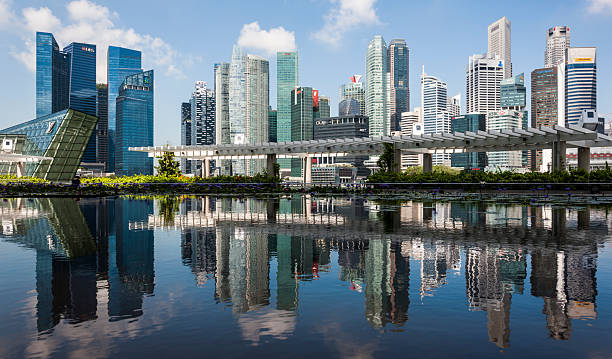
Singapore operates at a particular level of efficiency. Although the commute is short by regional standards, it is long enough that professionals have adapted to making the most of small pockets of time. In the CBD, tasks traditionally handled during lunch breaks fill those gaps. The evening, after the household has settled, offers a window for quiet productivity that disciplined individuals have learned to use. Reliable internet access across the city and consistent mobile connectivity along MRT lines make the environment well suited to screen-based activity with minimal friction. That is an ideal environment for online forex trading, and it is not a coincidence.
The continuous nature of the currency market aligns well with the time constraints of Singapore’s working life. Equity markets open and close at fixed hours tied to their local time zones, while the forex market runs continuously, with meaningful activity across most hours of the day. A trader available between 8AM and 10PM may find the London-New York overlap has closed, but Asian session setups are forming on JPY pairs and AUD/USD during that same window. Because the market does not close, traders can fit participation around existing schedules rather than restructuring their lives around a single opening bell.
Online forex trading has become accessible to a broad population, removing the technical barriers that once made it feel like a specialist pursuit. MetaTrader 4 and MetaTrader 5 are available on Android and iOS and allow a trader to manage open positions, adjust stop-loss levels, and view live charts from a phone during a coffee break at a hawker centre. The mobile experience is not equivalent to a multi-monitor desktop setup, and serious traders are not relying on mobile exclusively, but the ability to check and manage positions without being tied to a workstation changes how and when participation is practical.
The social infrastructure around trading in Singapore has developed into something genuinely useful for participants at all levels. Channels dedicated to specific currency pairs or trading styles sustain ongoing daily conversation, with participants posting chart observations, economic calendar reminders, and occasional trade setups. These vary considerably in quality, and it takes experience to separate the signal from the noise, but the better channels function as a form of ongoing market education that supplements more structured learning. For newer traders, sustained exposure to how experienced participants think and communicate about markets accelerates development in ways that studying alone does not.
Where trading is woven into the edges of a full life, risk management takes on a particular character. The boundary between trading time and everything else can blur, the impulse to check positions intensifies during meetings, the temptation to close a losing trade before bed grows, and a run of confidence can lead to oversized positions. Traders who have successfully integrated trading within defined personal boundaries tend to say that maintaining those boundaries is a harder discipline than the trading itself.
What this relationship with Singapore life ultimately produces is a category of market participants who occupy a space between fully professional and purely casual, a category that has long existed but has grown considerably more visible as access has democratized. That middle space has its own logic, its own risks, and its own rewards, and the Singaporeans who inhabit it are navigating its complexities in a manner consistent with the pragmatic and disciplined approach the city tends to bring to most things.